
Discussions
Nyt Wordle: A Brief Guide and Strategies
The New York Times Wordle (NYT Wordle) is a daily word-guessing game that challenges players to identify a five-letter English word in six attempts. Each guess must be a valid five-letter word; the game provides feedback via colored tiles: green for correct letter in the correct position, yellow for a correct letter in the wrong position, and gray for a letter not present in the target word. Wordle’s simple mechanics have made it a global daily ritual and a study in deduction, probability, and vocabulary.
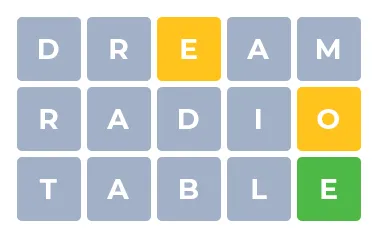
How the game works
You have six guesses to find the secret five-letter word.
After each guess, tiles change color:
Green: letter is correct and correctly placed.
Yellow: letter is in the word but in a different position.
Gray: letter is not in the word (or all instances of that letter have already been accounted for).
Repeated letters are handled carefully: if the target has one instance and your guess uses it twice, only one instance will be colored (green/yellow), the other will be gray.
Strategies for better play
Start with strong opening words
Choose a starter that covers common vowels and consonants (e.g., "ADIEU" for vowels, "CRANE", "SLATE", "SOARE" for mix of common letters). A good opener gives maximum information about letter presence and positions.
Balance information and targeting
Early guesses should prioritize uncovering letters. Once you have greens/yellows, shift to narrowing positions and ruling out possibilities.
Use letter frequency and patterns
English letter frequency helps: E, A, R, I, O, T, N, S, L, C are common. Consider common digrams/trigrams (TH, ER, IN, AN, RE).
Handle repeated letters carefully
If you see a green for a letter, consider whether the word might contain a second instance if your subsequent guesses indicate it. Avoid assuming uniqueness without evidence.
Process of elimination and mental bookkeeping
Keep track of gray letters and positions eliminated. Use patterns like A_E to mentally scan possible matches.
Avoid overfitting to short word lists
NYT’s list is curated and excludes obscure proper nouns and some archaic words, but it still includes less common terms occasionally. If you’re stuck, think of valid but uncommon common nouns and verbs rather than names or plurals with apostrophes.
Common mistakes to avoid
Repeating ineffective starters every day without adjusting based on feedback.
Ignoring letter frequency—guessing rare letters early can waste attempts.
Forgetting the Wordle rule for repeated letters, leading to incorrect assumptions.